Big Magic Book Study Session 2 Recap
Everything That Happened When We Read Enchantment

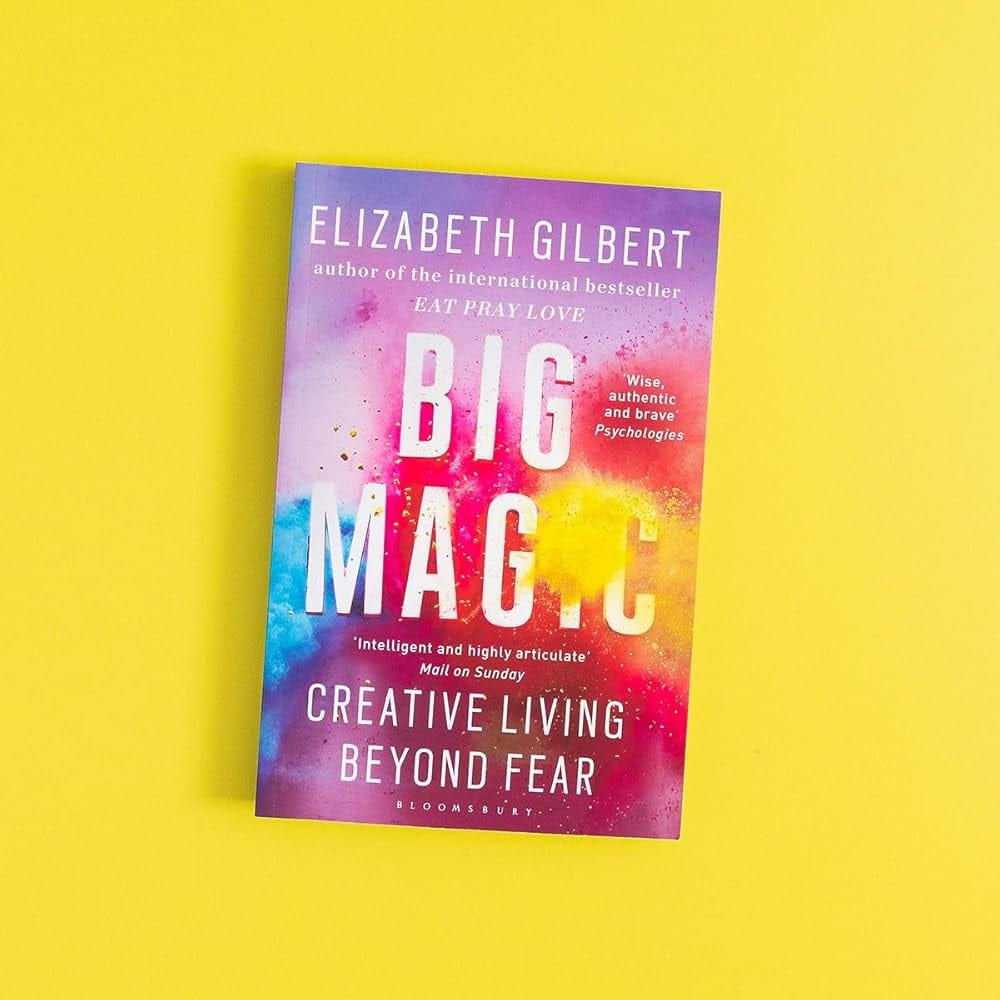
Some conversations start as a book study and become something else entirely.
That’s what happened at our last book study. For those of you who are new here, paid subscribers are invited to join our book studies every Sunday evening. Right now, we are reading Big Magic by Elizabeth Gilbert. Our past books have included Jesus and John Wayne and Separation of Church and Hate. After doing such heavy reading in the past books, we wanted to move forward with something to inspire and encourage us in our own lives.
We came in with Big Magic and Elizabeth Gilbert’s section on Enchantment, and her argument that creativity is mystical, that ideas have a life of their own, that genius was once understood not as something you are but as a household spirit that visits you. We left talking about plant consciousness, the neuroscience of piano practice, what it felt like to leave religious fundamentalism, and whether the origin of thought has ever actually been located in the human brain.
Spoiler: it hasn’t.
Here’s everything we covered.
The Roman Genius and Whether Gilbert Did Her Homework
We started, as we often do, with sourcing. Someone came to the call having already gone looking because in this day and age, anyone can take a minority opinion and make it the foundation of a major argument. The claim Gilbert makes about the Roman genius as a household spirit, the idea that creativity was something that visited the artist rather than something the artist was, and we wanted to know if that was real.
It is. The Romans really did believe this. And that matters, because it’s the foundation of her entire framework: that when we shifted, around the Renaissance, to saying someone is a genius rather than has a genius, we put all the credit — and all the blame — squarely on the artist. We made them fragile. We made them responsible for something that used to feel like a gift.
That shift — from has a genius to is a genius — is quietly one of the most important ideas in the book.
Meditation, Fundamentalism, and the Empty Mind
From there, the conversation moved somewhere unexpected: the fear of an open mind.
Several of us grew up in religious environments where meditation was treated as dangerous, not peaceful, not neutral, but actively threatening. The idea that if you emptied your mind, something would fill it. Evil spirits. A foothold for darkness. Frank Peretti came up (This Present Darkness). The old saying about blessing someone when they sneeze, protecting the soul from escaping through the open body. The logic of the vacuum: nature abhors it, and so does God.
And then someone pointed out, you can’t actually empty your mind. That’s not what meditation does. The research doesn’t support it. If anything, the harder you try not to think about the white bear, the more you think about the white bear.
What struck the group is how much of that fear is really just fear of curiosity. The fundamentalist framework treats open-mindedness as a door you shouldn’t open because what might walk through? And what Gilbert is doing in this book, in some ways, is saying: what if curiosity is the whole point?
The Neuroscience of Creativity — Left Brain, Right Brain, 2 AM
Someone mentioned that some of their best work happened at 2 AM — when the left brain gets tired and steps aside, and the right brain finally gets a little space. That connected to an activity used with 4th and 5th graders: Drawing on the Right Side of the Brain, where kids copy an upside-down Picasso sketch without knowing what it is, and end up producing something astonishingly accurate because they’re just following lines, not activating the brain’s stored symbols.
We store a “house” as a square with a triangle on top. We store a “bird” as an M-shape or an oval with a wing. The brain compresses images into the smallest version it can hold and reproduce. But when you actually look, when you bypass the catalog, something completely different comes out.
Is that true of ideas, too? How does the brain store ideas? How does it lose them? And do we sometimes compress ideas the same way — reducing something complex down to the smallest version we can carry — and then mistake that compression for the thing itself?
We didn’t solve it. But it’s a good question to carry into the next section.
Practice, Memory, and the Piano
One of our members has been returning to the piano, trying to remember how to memorize pieces the way she could as a child, when everyone in her neighborhood took lessons and played little soirees and felt like virtuosos.
This opened up a whole thread on the neuroscience of practice. There’s a music educator making the rounds on TikTok who explains that the frontal lobe, the thinking brain, hates repetition. It finds it boring. It wants to quit. But the more primitive brain stem loves repetition, and that’s the part that holds onto muscle memory. The only way to circumvent the fight is to gamify it, to make the practice feel like a level you can’t move past until you nail it.
One trick that came up: memorizing pieces from the end backward so that by the time you reach the part you’ve practiced most, you’re past the nerve-wracking middle and your nerves have calmed down.
And then someone said it: that’s not so different from what Gilbert is describing. The idea that’s been with you so long it lives in your body, not just your mind.
Plant Consciousness, Mycelial Networks, and Who the Stupid Species Really Is
From piano to plants, which is exactly the kind of conversation this group has.
The thread started with consciousness: a Stanford twin study on Netflix (You Are What You Eat) mentioned in passing that scientists can measure how the brain processes thought, but they cannot locate where thought originates. The origin of thought and awareness remains undiscovered.
That led to Michael Pollan, who believes plants have consciousness and has been pretty convincing about it. Which led to trees communicating through mycelial networks — sharing nutrients with their own offspring, sending distress signals through root systems, sensing toxins in the ground and routing around them. Which led to someone saying maybe the human species, so focused on this brain we carry around, is actually the stupid one because there are other forms of sophisticated intelligence we keep dismissing because they don’t look like ours.
One member, who has a background in neuroscience and meditation, brought it back around: altered states, whether through deep meditation, sleep deprivation, or other means, put the nervous system in places that look, neurologically, a lot like enchantment. And the more you practice reaching those states, the more your nervous system learns to recognize them. Enchantment, she suggested, might be something you train yourself toward.
Book recommendation from the group: The Light Eaters, about plant consciousness and communication, described as a little woo woo even by Oregon standards, but worth it.
What Is Enchanting You Right Now?
The question went around the group: What has been enchanting you lately? What are you noticing? What can you not stop thinking about?
One person said traveling, and not just the travel itself, but the humanizing of it. Going abroad and being asked by strangers: what’s it like in the U.S. right now? How are you coping? Sharing that with people back home who are afraid to venture far. Making peace, she called it. Making connection. And the reflection back: that is making something. You’re making memories. You’re making shared understanding. You’re making the world smaller and less scary for the people around you.
Someone else said woodworking, specifically the small boxes taking shape in the garage. And a quieter thought underneath it: that creativity might be a form of connecting to the infinite. That when a three-year-old sits down and plays Mozart like a virtuoso, maybe they’re not prodigies so much as people who are still close enough to the source that the signal comes through clearly.
Another person talked about the children’s stories sitting on a shelf, the novel started after a community crisis, the journal entries and half-finished things. The moment as a girl when an inspiration hit and she ran inside and couldn’t find paper and then shared it with her mother and didn’t get the response she needed, and sort of put the pen down after that. We talked about how much of creativity depends on having a receiver. The writer needs a reader. The painter needs a viewer. And how many artists through history made work no one cared about until after they were gone and whether that makes them more of an artist, or just more persistent.
And one person talked about the fear of running out of ideas and then a Noah Kahan interview where he admitted the same fear, which somehow made it feel more manageable. She’s also been returning to running, not for weight loss this time, but as a science experiment in creating boredom. Intentional downtime. Not thinking about anything. Letting the birds in.
The Labels We Carry
One of the most quietly powerful moments came when the group started talking about how American culture insists on categorizing people by what they do. In Germany, apparently, nobody cares what you do for work. They want to know what you’re interested in.
“Hi, I’m a teacher,” and that’s the end of the sentence. Versus: what are you curious about? What are you following? What lights you up?
Gilbert makes the argument that creativity gets crushed when we decide we are not creative people. That the label “I’m not a writer” forecloses something real. Several people in the group admitted to carrying versions of that label and we collectively, gently disagreed with every single one of them.
Coming Up: Permission
The next section is called Permission — and after everything we talked about Sunday, the timing feels almost intentional.
Who told you that you weren’t creative? Who told you that you needed a degree, an audience, or a better time in your life before you were allowed to make something? Gilbert has thoughts. So do we.
We’re also getting into Radiation Canaries and Werner Herzog, which are exactly as interesting as they sound.
This is a paid subscriber benefit. Your Zoom link is waiting for you on the other side.
If you’ve been on the free list for a while and keep meaning to upgrade, this might be your sign. A paid subscription gets you the Zoom link every Sunday, access to the full archive of analysis, and a community of people who read the fine print on everything.
Click subscribe, and I’ll see you Sunday night.
