

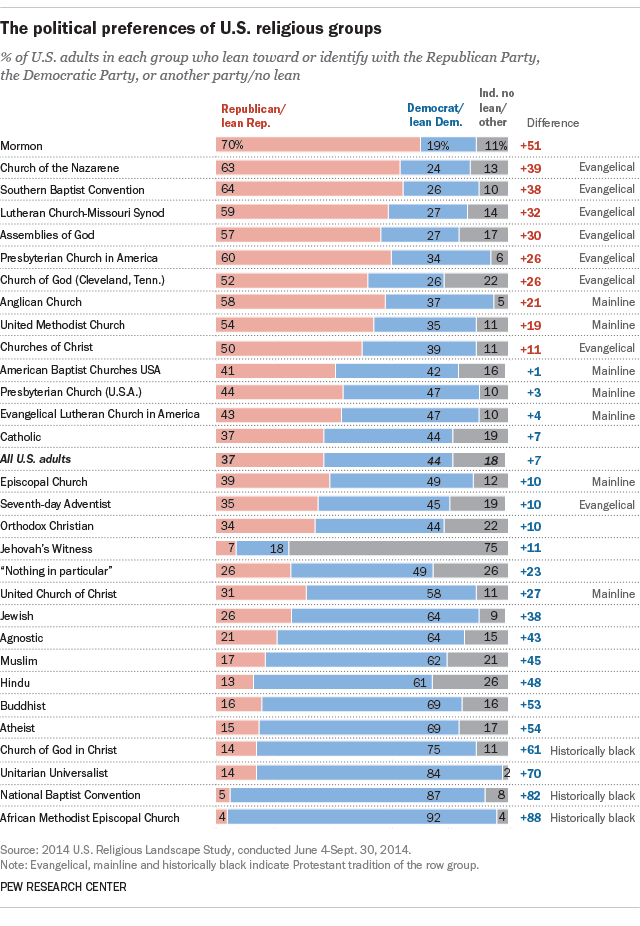
A lot of people are interested in the political makeup of congregations in this country. The chart above is from the 2014 Religious Landscape study, which was conducted by the Pew Research Center. I’m sharing it here as a broad example.
Some churches and political organizers are interested in individual church data. Like, who votes. Who votes after a sermon on the importance of voting? Who sits in a particular pew and votes for a particular candidate or party? That’s what we talked about this week in our book study of Katherine Stewart’s The Power Worshippers.
Some pastors don’t think about their congregation as a flock, rather but data points. What effect does that have on the relationship between a person and their spiritual leader? That’s what we spent last Sunday evening discussing … a conversion from being shepherded to being mined. Katherin Stewart presented this idea in chapter 9 of her book The Power Worshippers, although it wasn’t the first time I’d considered it.
Several years ago, I read about Paul Weyrich, the architect of the Moral Majority and a co-founder of the Heritage Foundation. His goal – from the books, articles, podcasts and documentaries I’ve consumed – was to turn congregations into voters, beginning in the 1970s. In order to do that, he needed access, data, and messaging.
The flock, converted into data
We started with a question: When a pastor’s flock gets converted into data, what does that do to the relationship between the person in the pulpit and the person in the pew? One member said, without hesitation, that it turns a shepherd into a manipulator. Another person shared that, in the Episcopal Church, she’s been told there’s only one shepherd, and everybody else is a sheepdog. That’s why they wear a collar. They keep the herd moving, but they aren’t the shepherd. It made me think about who actually tends to the herd and why.
A few weeks ago, my family watched The Great Sheep Detective with Hugh Jackman. His character reads detective novels to his sheep every night. Then, he gets murdered, and his flock helps a rookie detective solve the case. It is delightful in the most British of ways. What stood out to me was the importance of the shepherd. Do they care for their flock? Do they know their names, their temperaments, and their likes? Or are they in it for the money?
I shared a story about my friend. After she went through a divorce with her husband, who was a pastor, it was a little difficult for her to go to church, again. She finally found a place where she felt like she belonged. She joined a small group. One week, the small group leader shared he had been given a directive to report any concerns about the group member to the pastor. Was he a spy? Is this space safe? Was she being judged? What was framed as a warm, welcoming small group turned out to function more like an intelligence operation than a Bible study.
One member nearly interrupted by their realization that it was dominion theology at work. Another noted that a small group is supposed to be said in confidence, among people you trust as friends. That’s clearly not what was happening. While this wasn’t about directing votes in this case, it seems to be about knowing the behavior of the congregation, which leads to the question … why?
Ananias, Sapphira, and the tithe pledge
We talked about a new-member class that opens not with welcome, but with a pledge card saying how much will you tithe. And people are asked to sign this before you have even committed to membership, youth group, nursery help. One member connected it to the story of Ananias and Sapphira, struck dead for lying about how much they’d given. It’s one of those stories that’s always bothered me, honestly, and his read helped. He felt that story was less about lying in general and more about the legalism of the tithe itself. It seems like generosity becomes more like an amount that’s audited.
Another member made the point that pledging itself is common practice for budgeting purposes, but doing it in a newcomer’s class is a different animal entirely. As she put it, “it almost sounds more Mormon” than anything she’s used to.
The voter file and the church roster
This was the part of the chapter that actually unsettled one of our members. Stewart writes about the practice of taking a church’s membership roster and matching it against the public voter file. Then, they would measure how many members voted before the pastor’s “encourage everyone to vote” push, and how many after. Not who they voted for — that’s not public — just whether they showed up. One member was surprised this happens at all. Another wasn’t surprised in the slightest.
I found myself thinking about how this is public information in Indiana. Here, it’s public information to see which ticket someone pulled in a primary, but I had never considered the likelihood of someone pulling a church directory and cross-referencing it against that file until this chapter put the idea in my head. A member also pointed out that it doesn’t have to be the pastor doing this. It could be anyone in the congregation with access to the roster and a political itch to scratch.
Isegesis dressed up as exegesis
One member brought up Scott Spages misreading Proverbs, “when the righteous rule, the people rejoice; when the wicked rule, the people groan,” and turning a statement of fact into a call to action … therefore, Christians are called to install Christian leaders. His line for this was perfect and I’m stealing it: exegesis is pulling meaning out of the text; isegesis is putting your own meaning into it. Spages is isegeting.
I made the point that Proverbs is wisdom literature, not a governing manual, and that Jesus himself never aspired to be a Sadducee, a Pharisee, or a king. His ministry was one-on-one. The only time he got visibly angry was the money changers in the temple, a detail I keep on my dining room wall, actually, in a David Hayward cartoon. Another member added that he also cursed a fig tree, but that’s the whole list. Two incidents. Everything else we know about him is relational, not institutional. We don’t even have that secondhand account for 30 years after his death, from a set of followers with, at best, a first- or second-grade level of education. Matthew, the tax collector, probably had a bit more. Paul was the outlier. He was the one person in the movement with the schooling to write his own material from the start.
We also got into Bill Dallas’s line about not letting the culture take over so it “doesn’t smell like us,” biblical values, unnamed and undefined. One member called it a rhetorical sidestep, a way to gesture at Christian nationalism without committing to the specifics, so you keep deniability. Another member responded that the biblical values she holds and the ones her conservative brother holds are “vastly different,” so whose values are we smelling, exactly?
Voter guides and the discomfort of correcting people
I asked whether a “rank candidates by biblical values” voter guide, without a named political party, is technically not an endorsement of a candidate. Is that a meaningful legal distinction or just a workaround for what tax law won’t let a pastor do directly.
One member said she wouldn’t call it out to her neighbor directly, because doing so assumes she knows better and that’s its own kind of disrespect. Another member’s approach was different. For them it was not about attacking the conclusion someone lands on, but asking about the presuppositions that got them there. Asking someone why they believe something, rather than just exchanging ideas or positions, doesn’t always work, but it’s more honest than silence or a lecture.
Your data, showing back up
Toward the end of our meeting, I asked if anyone has noticed their own data resurface later as messaging aimed at them? One member shared that after her husband broke his neck, a hospital care coordinator referred her to a couple of meal delivery services, and within days the ads were all over her Facebook feed. It went quiet for months and then came roaring back this week.
It’s the same mechanism as the Target pregnancy-prediction mailers, or the hospital system I used to work for sending mammogram reminders to women who’d simply mentioned their age at a checkup. None of us could point to a church doing this directly to us … small parishes, mostly, no directory apps, no check-in software, but one member’s sister-in-law’s Methodist parish in Albuquerque did require sign-ins long before anyone was thinking about where that data would land.
Always read the fine print. If you enjoy my writing and thinking, consider becoming a paid subscriber. That gives you access to our Sunday night book club on Zoom, my complete Historians Notebook and access to history classes on Tuesday evening Zoom meetings and early access to the curriculum I’m creating. The link to this Sunday’s Zoom meeting is below the paywall. We’ll be continuing this study for a few more weeks before we move on to our next book, either Fever in the Heartland or Why Fish Don’t Exist. Racial issues come up pretty often in our discussions about the evangelical movement in America. Let’s dig into why.
