Ethics vs. Control
Book study recap, reflections and information for this week.

John Fugelsang opens one of the chapters in Separation of Church and Hate with a reminder that startled me the first time I heard it: Jesus had remarkably little to say about sex.
Which is fascinating, considering how much time modern Christians spend talking about it.
Last Sunday evening, our book study landed on Fugelsang’s chapter about sexual hangups. We’ve already worked our way through chapters on immigration, abortion, and poverty. This week was sex. The conversation ranged everywhere: childhood memories, church culture, dress codes, patriarchy, fear. It didn’t end with a neat conclusion, but it did leave me noticing patterns that show up again and again in both religious spaces and the wider culture.
Sometimes those patterns are subtle. Sometimes they’re impossible to ignore once you see them.
Everything and nothing at the same time
When I think about how sex was talked about when I was growing up, the best description I can give is this: it was everything we talked about and nothing we talked about at the same time.
It was treated like the most dangerous force in the universe, but also something that couldn’t be discussed like a normal human topic. I remember the permission slip for sex education in school and the awkward conversations at home. I remember the shame that seemed to hover around the whole subject.
My mom handed me a library book about menstruation because she couldn’t quite say the words herself. Most of what I learned about periods came from television characters.
Looking back, what stands out to me now is not just the lack of information. It’s how much fear surrounded the topic. The message wasn’t simply “be careful” or “treat people well.” It was that sexuality itself was something threatening, something that had to be tightly managed before it could spiral into disaster.
Fear has a way of shaping how we learn things. It sticks with us long after we’ve outgrown the environment that produced it.
The things that stay with you
One woman in our group shared a moment with her daughter that stayed with me. She had already left Mormonism years earlier, but while watching Dancing with the Stars she caught herself making a comment that a couple of the dancers must not be very good Mormons because of how they dressed.
Her teenage daughter immediately pushed back. How could you judge someone’s spirituality based on what they wear for their job?
It stopped her cold. She realized that even though she no longer believed the rules she grew up with, some of the instincts were still there.
That’s the tricky thing about growing up inside strong cultural or religious frameworks. You can stop believing something intellectually and still find traces of it living in your reflexes. Sometimes it comes out in the way we talk about clothing. Sometimes in the assumptions we make about other people’s choices. Sometimes in the quiet expectations we carry about what women should or shouldn’t do.
Leaving a belief system doesn’t automatically erase the habits it taught you.
The burden that lands on women
As the conversation moved around the group, another theme kept surfacing. Again and again, the responsibility for sexual morality seemed to land on women.
Women should dress carefully. Girls should avoid tempting boys. Teenage daughters shouldn’t wear certain swimsuits. Church camps required girls to wear T-shirts over two-piece bathing suits, even when the swimsuits themselves were modest.
The underlying message was rarely stated outright, but it was always there: your body is responsible for someone else’s reaction.
That message shows up outside church walls too. Someone talked about her daughter’s volleyball uniform looking more like a swimsuit bottom while the boys’ athletic uniforms covered them to the knees. Another person mentioned cheerleading uniforms that couldn’t be worn during the school day because they were considered too revealing, even though they were standard athletic gear.
When you step back and look at it, the pattern becomes difficult to miss. Rules about modesty and morality are often framed as protecting people, but they frequently end up regulating women’s bodies far more than men’s behavior.
The moment that made me leave
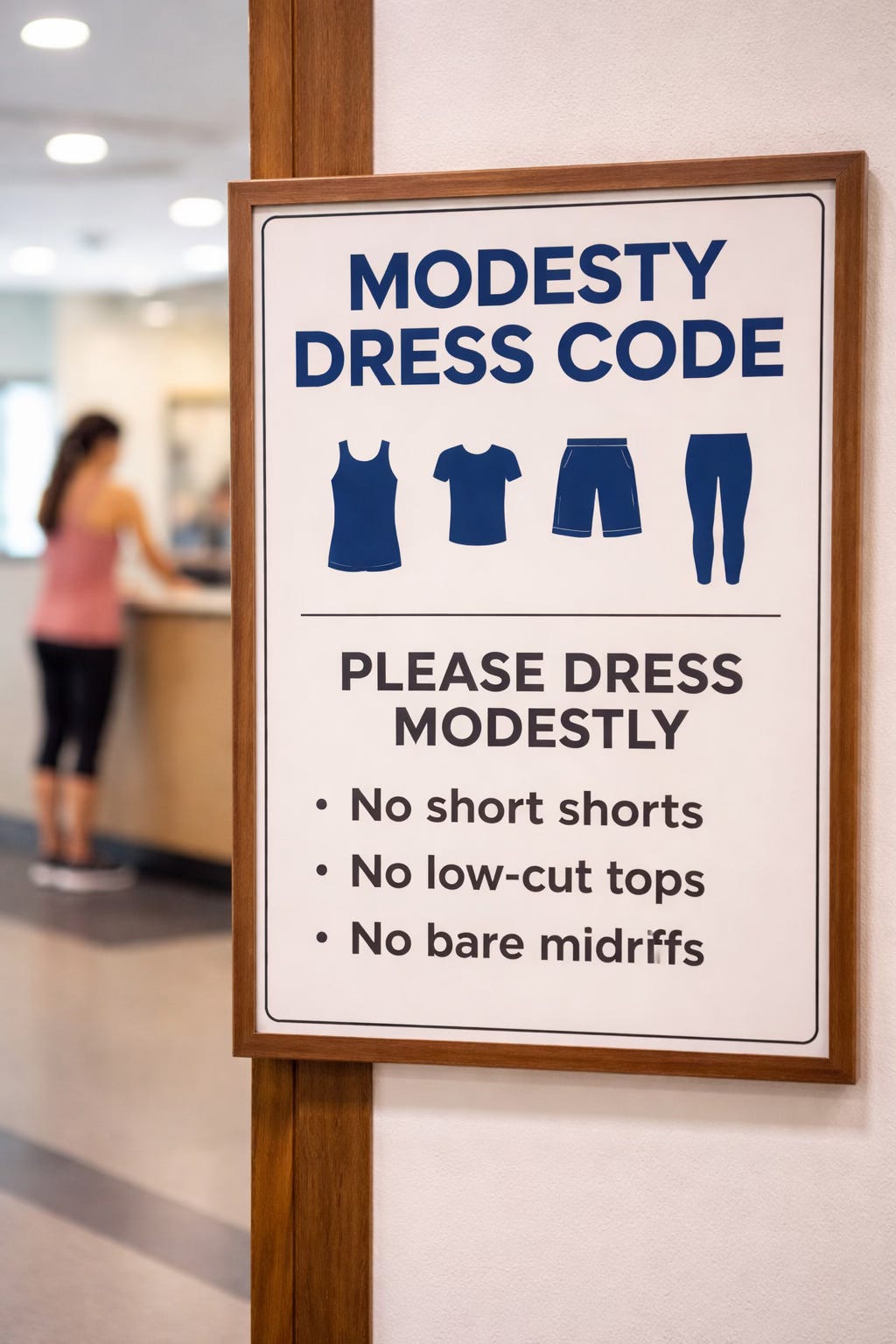
At one point I shared the thing that finally caused me to leave the local YMCA.
There were Bible verses posted around the walking track. Christian radio playing overhead. Fox News running on the television.
And then there was the dress code sign.
One of the rules specified that shorts must have a three-inch inseam or longer.
Now, technically, the sign didn’t say it applied only to women. But let’s be honest for a moment. Do most men even know what an inseam is?
I had a pretty good sense of who that rule was actually aimed at.
That was the moment I realized I was done. Not because of the rule itself … people are free to create dress codes in their own spaces. But because the pattern had become impossible to ignore. In a place that claimed to welcome everyone, women’s bodies were still being quietly monitored in the name of morality.
Once you start noticing that pattern, it becomes hard to unsee it.
What Jesus said … and what the church says
One of the more surprising parts of Fugelsang’s chapter is simply noticing the gap between how much Jesus spoke about sex and how much the modern church does.
Jesus talked far more about compassion, humility, hypocrisy, wealth, and caring for the vulnerable. But sexual behavior has become one of the central moral battlegrounds in many religious communities.
Paul’s letters often get pulled into these conversations too, even though those letters were written to specific communities dealing with specific situations at particular moments in time. The people who wrote those texts were addressing real issues inside early churches, not drafting a universal rulebook for centuries of future societies.
Sometimes the way those passages are used now feels less like guidance and more like regulation.
Sexual ethics versus sexual control
Toward the end of the discussion, someone offered a distinction that helped clarify the conversation.
Sexual ethics has to do with respect. Respect for bodies, respect for relationships, respect for consent, honesty, and care. Ethics focuses on how people treat one another.
Sexual control, on the other hand, tends to focus on monitoring behavior and enforcing rules, often unevenly. It asks who gets to decide what is acceptable and who gets to enforce those boundaries.
Ethics asks how we treat people well. Control asks how we keep people in line.
That difference showed up in nearly every story we shared that evening.
The role fear plays
Fear also surfaced repeatedly in the conversation. Fear that a daughter might get hurt. Fear of pregnancy. Fear of disease. Fear of losing influence over children as they grow older.
Those fears are real, and many of them come from love. Parents want to protect their kids. Communities want to prevent harm.
But fear can also become the engine behind control. When fear starts driving the conversation, it can crowd out compassion and turn complex human experiences into problems that need to be managed.
And once fear takes over, it becomes very easy to convince ourselves that control is the same thing as care.
Untangling the threads
At one point I tried to describe what all of this feels like in my mind.
Imagine opening a drawer full of embroidery thread where everything has been tangled together.
Religion.
Patriarchy.
Cultural expectations.
Personal experience.
Fear.
It can be difficult to tell where one strand ends and another begins. And maybe the task isn’t to untangle every thread perfectly.
Maybe the work is simply learning to notice which strands lead to respect and which ones lead to control.
One sentence I’m holding onto
During the conversation a participant shared a sentence she had saved earlier in the week:
Forgive yourself for not knowing earlier what only time could teach.
For anyone who grew up inside systems that mixed fear, morality, and control together, that line feels important.
Learning to separate those things takes time. Sometimes a lot of time. Conversations like the one we had Sunday night don’t solve everything, but they do help us see the threads more clearly.
And once you start seeing them, it becomes easier to decide which ones you want to keep holding and which ones you’re ready to let go.
A Zoom link and Information for this week’s study is below the paywall. All are welcome to join, even now. Fugelsang’s book is written in such a way that you can pick up anywhere and join in. We’d love to have you.
Keep reading with a 7-day free trial
Subscribe to Lindsay Winslow Brown to keep reading this post and get 7 days of free access to the full post archives.