The Same Circle
Someone wrote “massacre” over “battle” on a federal highway sign. It took me 30 years to understand why — and what it has to do with the Supreme Court case being decided right now.

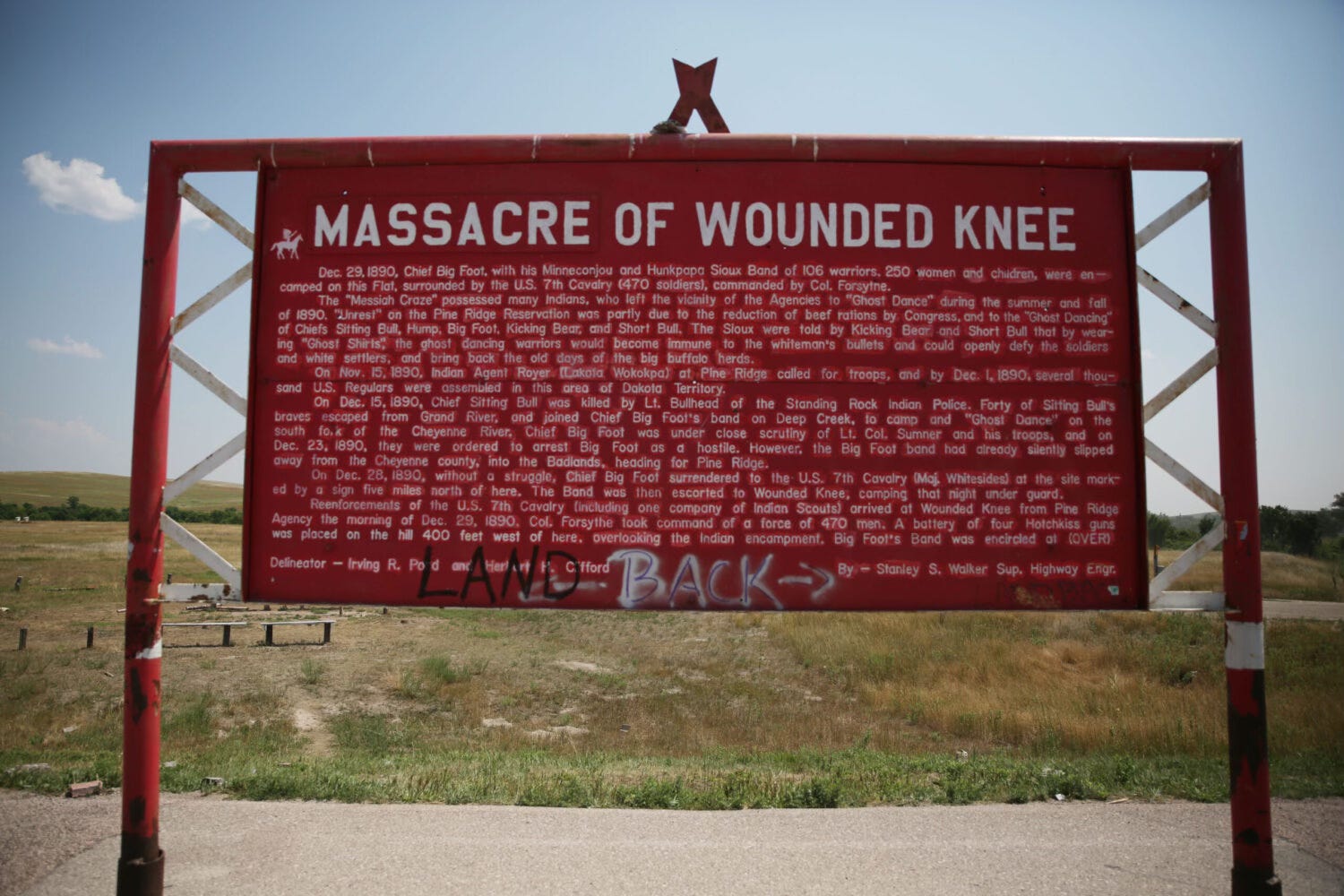
I didn’t start writing this because of Native American history. I started writing it because I kept hearing arguments about the 14th Amendment — about birthright citizenship, about who belongs, about who is truly subject to American jurisdiction — and something kept nagging at me. I had heard these arguments before. Not in the news. In the history books I was reading.
This is the second piece in an ongoing series connecting American history to the headlines of 2026. The first piece — “The Supreme Court Takes on Birthright Citizenship” — is available in the archive.
The Church Bus
When I was 15 years old, a church bus carried me 2,500 miles from Indiana to Crow Agency, Montana, to help paint houses.
I didn’t know what I expected. But it wasn’t this.
The streets were paved. There was a post office. A church. The houses looked like houses in my neighborhood back home — just poorer. So poor that someone decided what they needed was a group of Indiana teenagers with paintbrushes. We washed our clothes at the laundromat that week. I remember thinking that was an adventure.
I was 15. I didn’t understand that for the people who lived there, it wasn’t an adventure. It was just Tuesday.
We slept on the floor of the church sanctuary. Showered in a little building next door. Made all our own meals. I remember riding with the woman who handled the cooking on a supply run to a Sam’s Club in Billings — 40 miles away. A real city. Real stores.
We had brought our own world with us. We dipped into theirs just enough to paint a few houses and take a few pictures. And then we went home.
At a rodeo that weekend I asked a man if I could take his picture. He had long black hair and was wearing traditional clothing and I assumed — because of course I did — that he was a member of the tribe. He said yes. I smiled. I still have the photo somewhere.
But something felt off that I couldn’t name at 15. The dancing felt performative. Like something being displayed rather than lived. Like a memory of a life, not the life itself.
I didn’t see any of it clearly then. I thought we were helping.
I’m not sure anyone on that trip asked the Crow people what they actually needed.
I went home to Indiana carrying that feeling without a name for it. And I left it there. Unpacked it, put it on a shelf somewhere in the back of my mind, and got on with growing up.
Six years later I was 21, newly in love, and driving west again.
The Sign
My husband — then boyfriend — and I nerded out over history. Right after he took the bar exam one summer we threw a tent in the back of the car, grabbed a cooler and a few changes of clothes, and headed west. We followed the Lewis and Clark trail from Independence, Missouri, stopping at markers and visitor centers along the way.
We read every plaque. We were that couple.
But the sign I remember most wasn’t about Lewis and Clark.
It was one of those brown federal highway markers with yellow lettering. The kind you see outside national parks and historic sites all across the country. Official. Authoritative. Permanent.
This one said something about the Battle of Wounded Knee.
And someone had taken it upon themselves to add a word. In paint or marker — I can’t remember exactly — someone had written “massacre” over the word “battle.”
I stood there looking at it for a long time.
The federal government had called it a battle. Someone — I don’t know who, I don’t know when — had decided that wasn’t the right word. And they had said so in the only way available to them. On the sign itself. In permanent ink on a permanent marker that the government put there to tell us what happened.
That unnamed feeling from Montana suddenly had a question attached to it.
What happens when the official story isn’t the true story? And who gets to decide which one goes on the sign?
That question eventually led me to Mary Annette Pember. And her book “Medicine River.” And 30 years after that church bus dropped me off in Crow Agency — I finally started to understand what I had seen.
The Journalist and the Archive
When I came across Pember’s “Medicine River” I understood immediately why she wrote it.
Pember is a journalist. So am I, or was — and once you have that instinct it never really leaves you. The drive to find the document. To follow the footnote. To sit with an uncomfortable truth and not look away even when looking away would be so much easier.
Her mother had attended a boarding school. Pember couldn’t ask her about it directly — that door was mostly closed. But she could research. She could report. She could go to the archives and pull the records and try to understand what had been done, even if understanding it wouldn’t fix it. Wouldn’t reconcile it. Wouldn’t make it make sense.
I get that drive. I’ve felt it myself.
“Medicine River” was published in the wake of the 2022 federal Indian boarding school report — the first time the United States government had ever formally investigated what it had done. 408 schools. 37 states. Children as young as 4. Burial sites at 53 of those schools, with more expected as the investigation continues.¹
Pember gave that report a human face. Her mother’s face.
And reading it, I kept thinking about a 15-year-old girl on a church bus heading to Montana with a paintbrush and absolutely no idea what she was driving into.
You know the headlines. The rest of this piece is the fine print.
If you’ve been following this series you know I don’t write history lessons. I write connections. What follows connects a papal document from 1493 to a Supreme Court argument from 2026 — with stops at the boarding schools, the Dawes Act, and a man named John Elk who just wanted to vote. It’s for paid subscribers. I’d love for you to be one.
