They Brought Flowers
The forgotten origins of Memorial Day, a 103-year-old veteran, and the thread that connects them to a courthouse square in Indiana.

I like to pull on strings and find their ends.
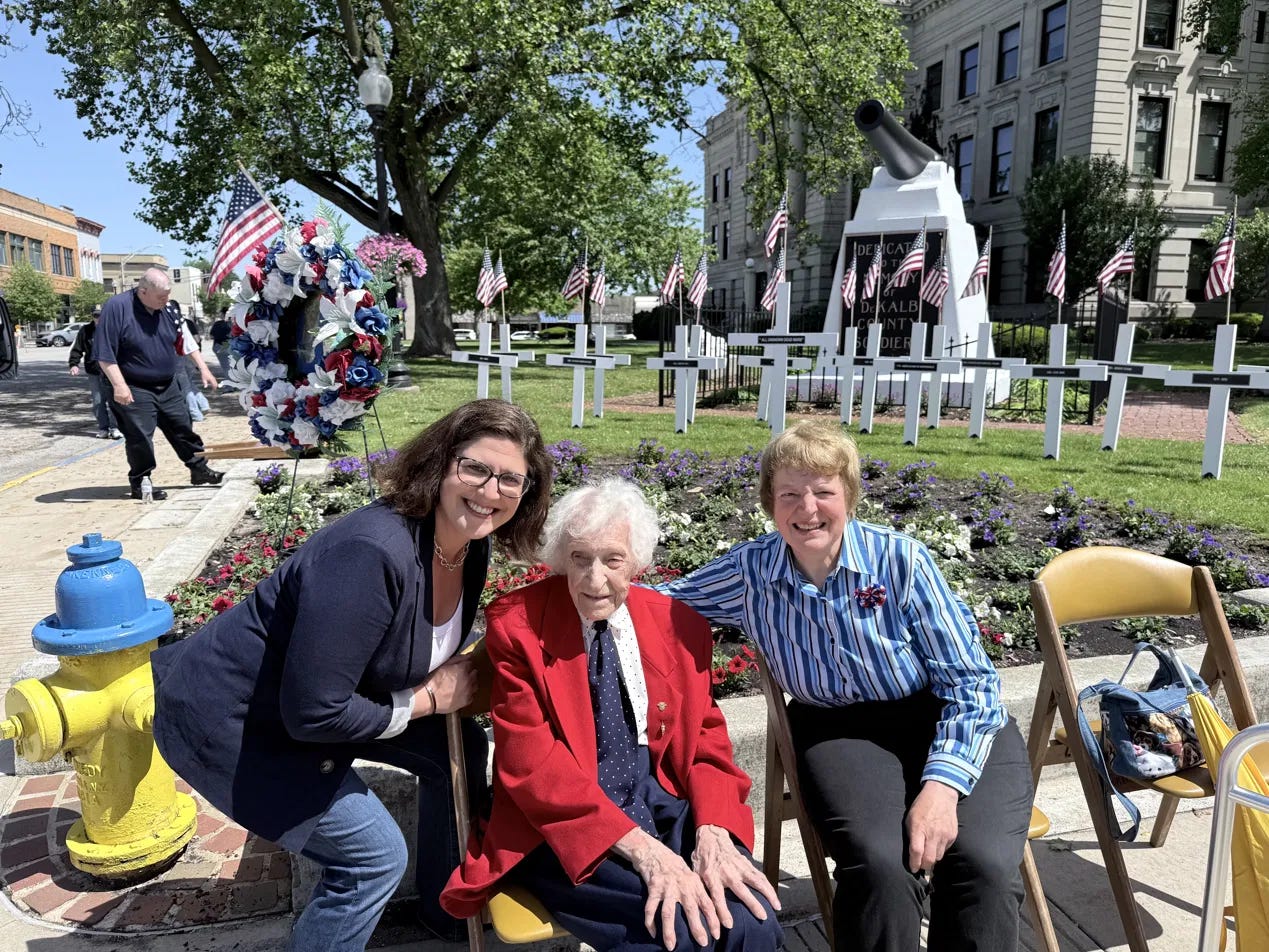
This morning I was sitting at a Memorial Day service, as I usually do in my quaint midwest town. For a few years I covered it as a reporter in my early 20s. I’ve been to a lot of these ceremonies. And this morning I was struck by the local speaker, Nancy Bates, a West Point graduate. But she wasn’t sharing her own accolades. She was talking about her mother, Ellen Bates, DeKalb County’s oldest living veteran. She’ll turn 104 in July.
She said that when her mother was a little girl she took a coffee can wrapped in foil and filled with lilacs to a bridge over a local creek and threw them in for Decoration Day.
Then I realized, this was a thread I hadn’t pulled on yet.
When Nancy got up to speak, my first thought was “how refreshing, a woman and a West Point graduate.”
Throughout the ceremony, my mind wandered a bit. I knew Memorial Day had started as Decoration Day after the Civil War, but I couldn’t remember when or where.
So I started thinking about the beginnings of Memorial Day. A quick Google search reveals the federal government recognizes Waterloo, New York, as having the first festivities. Or General John Logan in 1868, when he and others gathered at Arlington National Cemetery to commemorate the deaths of the hundreds of thousands of soldiers who died of wounds or disease during the Civil War.
You may hear about revisionist history and think that it’s people going back and rewriting the past. It’s not so much changing the past as adding perspectives to how we understand it. For example, modern historians now believe that 670,000 soldiers died in battle or of disease during the Civil War, but that number wasn’t known at the time. Perhaps hundreds of thousands is more accurate for the context of 1868.
Interestingly, Arlington National Cemetery didn’t exist before the Civil War. If you go to Arlington today you can still see a house on the hill. That was the home of Confederate general Robert E. Lee. The home was built by Lee’s father in law, George Washington Parke Custis, the adopted grandson of George Washington. Yes, that George Washington. Literally, a man who helped found our nation is connected to the home of the leader who led the secession.
Shortly after Virginia seceded in 1861 Mary Anna Custis Lee left the home, but sent a letter to Union leaders asking that they respect her property. Clearly that was ignored, much like Trump ignored Jackie’s rose garden and turned it into a patio.
Union Quartermaster General Montgomery Meigs hated Lee for what he believed to be treason. He ordered the burials to be as close to the house as possible. The hatred ran deep. Earlier in life Meigs had served under Lee in the Army Corps of Engineers. Whatever respect Meigs once had for Lee was gone by the 1860s.
And Lee himself was connected to Washington. His father, Light Horse Harry Lee, was a cavalry commander during the Revolutionary War. Washington delivered Harry’s eulogy.
When I see how divided our nation is now it reminds me of this period of history, where people who literally fought together, mourned together, and celebrated together fought each other because their ideologies could not find a way to reconcile themselves together.
And this brings me back to Memorial Day, something we can all agree on. Many people died fighting for the freedom we have in this country. And like the divisions we see today, Memorial Day’s beginnings are also divided. The official story features generals and federal designations, but there is another story that was found on a piece of cardboard by a Yale historian in a Harvard library in the 1990s.
I’m talking about David Blight, who went on to become a Pulitzer Prize winning author. While researching a book on the Civil War at Houghton Library at Harvard University, he came across an unorganized box of veterans’ records. Inside was a piece of cardboard labeled “First Decoration Day.”
Inside this unorganized box was a handwritten narrative of the first Memorial Day observance — on May 1, 1865, less than a month after the end of the Civil War. That narrative mentioned an article in the New York Tribune. Sure enough, with a little more digging, Blight found the article.
What he discovered had been hiding in plain sight for over a century.
Confederate forces held Union soldiers as prisoners of war at a racetrack in Charleston, South Carolina. When they left, freed Black residents and a few white Christian missionaries discovered a mass grave with 257 bodies. They exhumed the bodies and reburied each of them in individual graves.
They enclosed the area with a white picket fence and hung a sign on the archway that read “Martyrs of the Race Course.” On May 1, approximately 10,000 people gathered to pay their respects to the dead. Three thousand schoolchildren attended, carrying roses and singing “John Brown’s Body,” a Union song. Union soldiers marched around the racetrack. There were so many flowers, it looked as if it were a field floating into the sunset.
No one was setting out to start a national holiday. The memorial was an outgrowth of the grief and gratitude that surfaced at the end of war. It was the outpouring of emotions in response to newfound freedom. It wasn’t as if someone who attended wrote a letter to Andrew Johnson, the southern Democrat president at the time, and said “hey, let’s start this.” There wasn’t a petition with thousands of signatures. It was a localized event honoring those who gave the ultimate sacrifice.
And at the same time, it disappeared into history. By the end of Reconstruction in 1877 it was forgotten. Waterloo, New York got the federal recognition for the first observance and all eyes went to Arlington.
Frederick Douglass, a formerly enslaved man, abolitionist, and one of the most important voices of the 19th century, stood at Arlington National Cemetery on Decoration Day in 1871 and said:
“Dark and sad will be the hour to this nation when it forgets to pay grateful homage to its greatest benefactors.”
He was already worried. It had only been six years since the end of the war.
Decades later, David Blight would document in his Pulitzer Prize winning book Race and Reunion: The Civil War in American Memory exactly what Douglass feared had come true — that the unity of white America after the war was purchased through the erasure of Black memory and the story of emancipation.
I believe history belongs to everyone. The story of what happened in Charleston on May 1 1865 — the racetrack, the mass grave, the archway, the 10,000 people, the field of flowers floating into the sunset — that story is sourced, documented, and free to read above. Primary sources and scholarly research should be accessible to anyone who wants to understand where we came from.
What comes next is mine. My morning in Auburn, Indiana. The woman in the red jacket. The coffee can wrapped in foil. What it felt like to sit beside my 10 year old son and watch a daughter honor her 103 year old mother in a courthouse square surrounded by white crosses. That part — the analysis, the personal thread, the place where history becomes human — that’s what paid subscribers make possible.
If you’ve read this far and it moved you, consider becoming a paid subscriber. Not for access to more facts. But for the conversation about what those facts mean — and why they still matter today.
