
They Were Already Here
What Juneteenth made me go looking for — and what I found underneath my own hometown in Indiana

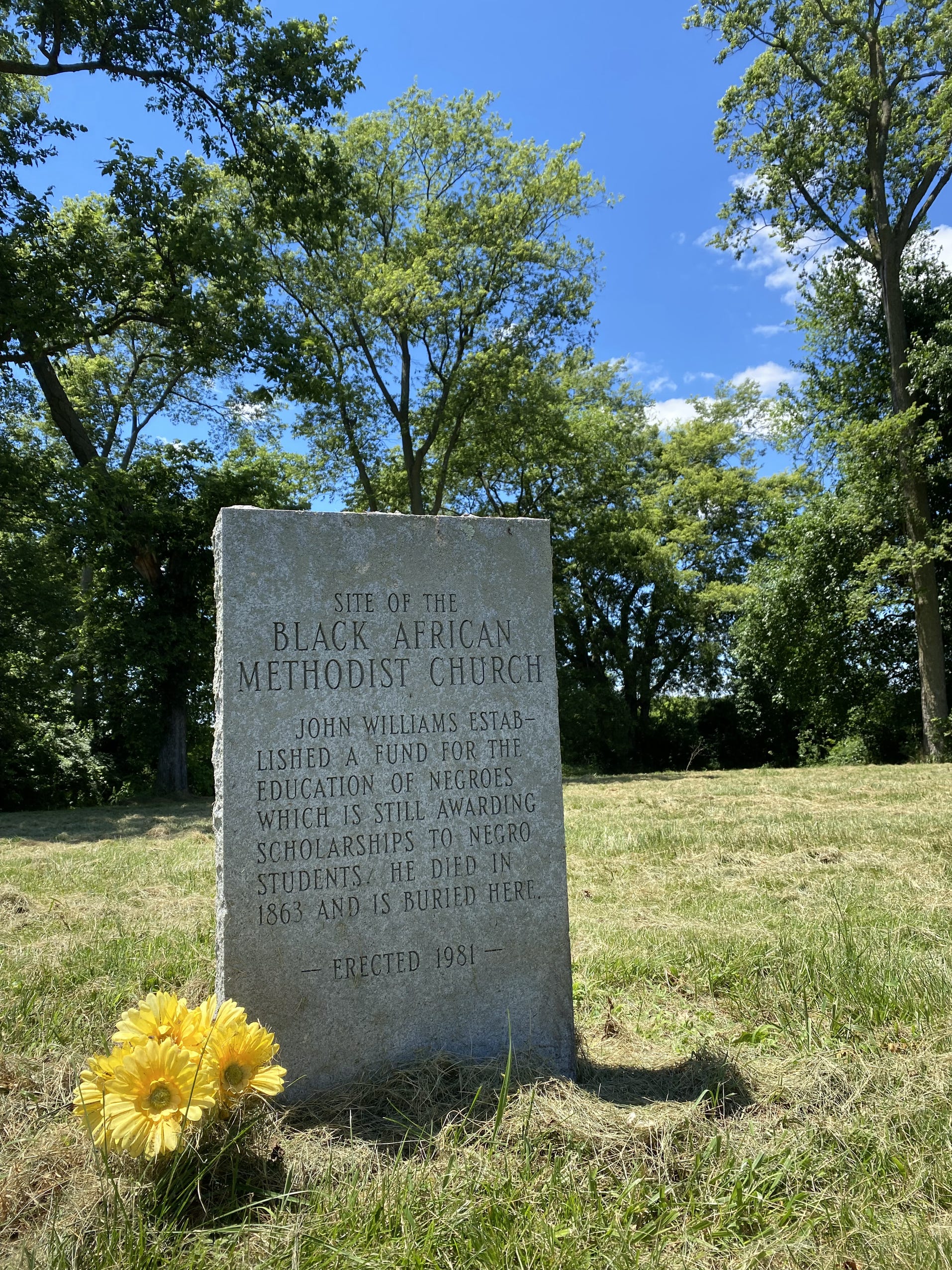
I’ll be honest about how this started. I knew what Juneteenth was. In my mind, it marked the day the enslaved people were freed. But I also knew the Emancipation Proclamation marked that — January 1, 1863. And this year, for whatever reason, the two dates finally bumped against each other in my head. January 1, 1863. June 19, 1865. Two and a half years apart. Both of them, somehow, “the day the slaves were freed.”
That doesn’t line up. So I went looking for why.
And the first thing I learned was that the version in my head was wrong.
Growing up, we learned that the Emancipation Proclamation was issued on New Year’s Day, 1863. In my young mind, that meant the enslaved people were free. January 1, 1863 — freedom. Clean as that.
It wasn’t clean. It wasn’t even mostly true.
The Emancipation Proclamation only applied to states in rebellion — Confederate territory the Union didn’t actually control. It deliberately exempted the loyal border states, Kentucky and Maryland and Missouri and Delaware, and the parts of the South already under Union occupation. Sit with what that means. The proclamation declared people free precisely where the United States had no power to enforce it, and it left slavery untouched precisely where it could have acted. Freedom on paper, in the one place the paper couldn’t reach.
Which is why Juneteenth exists at all. June 19, 1865 — two and a half years later — is the day Union troops finally reached Galveston, Texas, the last far corner of the Confederacy, and enforced what the proclamation had promised. The enslaved people there had been “free” on paper for nine hundred days and didn’t know it, because freedom was only ever as real as the soldiers who arrived to enforce it. The Thirteenth Amendment, the thing that actually ended slavery everywhere — including those border states the proclamation never touched — wasn’t ratified until that December.
A law without enforcement means nothing. That’s the lesson I took. And then I started thinking about my own state, and I realized Indiana taught the same lesson in reverse — a law that was enforced, ruthlessly, in the other direction.
This is the kind of thing I dig into every week — the fine print they left out of the textbook. It's free. Come along.
Here is the thing I was never taught.
In 1851, Indiana wrote a new constitution. Tucked inside it was Article XIII, and it said, in plain language, that no Black person could come into or settle in the state. Not couldn’t vote. Not couldn’t go to school. Couldn’t live here. And this wasn’t slipped past anyone — it was pulled out and put to the voters as its own separate question. Indiana’s voters, white men, the only ones permitted to vote, ratified it: 113,828 in favor, 21,873 against. The people the law was aimed at had no say in it. Of course they didn’t. That was the point.
A free state, in the Union, voted on purpose to keep free Black people from making a home here.
But here’s the part that turns the whole story over: they were already here.
The Indiana Historical Society says it plainly — the popular understanding of Black Indiana history skips ahead to the cities after the Civil War and erases the free Black families and formerly enslaved people who had been building communities here long before. They were farmers and landowners and church-builders. They predate the ban. Article XIII wasn’t stopping something from happening. It was trying to reverse something that already had.
I know this now because of a sign. Not as a child — I was married, and a mother, before I ever found it. A marker on the site of an African Methodist Episcopal church in Washington County, where I grew up. It caught my interest, and I went looking, and what I found was a whole world that had been sitting underneath my hometown the entire time.
Washington County had Black settlements — agrarian, prosperous, with churches and schools and cemeteries. A man named John Williams became wealthy by any standard of his day, owning 160 acres of good farmland. He established a fund for the education of Black students that, according to the marker, was still awarding scholarships generations later. He died in 1863 and is buried at the church site. The record is blunt about how he died — presumably at the hands of white assailants. Another man, Alexander White, considered the town’s last Black resident, was murdered in 1867 as he left church. His wealth had inexplicably vanished. No one was ever convicted for either killing.
And then you can watch the law do its work, right there in the census. Washington County counted 252 Black residents in 1850. By 1870, eighteen. For the next century, single digits. The Indiana Historical Society does not call this a decline. It calls it a crusade to drive African Americans away, followed by decades of erasing any sign they had ever been there — properties, institutions, and cemeteries consumed, looted, or destroyed.
By 1898, Salem — my county seat — had become a sundown town. A place that was all white on purpose, where Black people were not permitted after dark. Notice the timing. The community was already gone by 1870. The sundown rule came a generation later. They had driven the people out, and then they kept enforcing the emptiness.
The machinery behind all this was real and it was funded. The state required Black residents to register with the county — name, age, description, witness — in official Registers of Negroes and Mulattoes. The state created a Board of Colonization, paid for partly by the fines collected from Article XIII violations, to ship Black Hoosiers to Liberia. Almost no one went. Thirty-three people in the peak year. The board’s own secretary eventually declared the whole project a failure and blamed it on Black Hoosiers’ refusal to accept that they couldn’t be equals here.
One of the people that machine tried to use was a man named Willis Revels. He was an AME minister in Indiana, and in 1845 the Indiana Colonization Society tried to hire him as its agent — to travel to Liberia and come back and sell the idea to other Black Americans, to win their confidence in their own removal. After his own denomination protested, he refused to go and refused to support it.
Willis had a brother. His name was Hiram Rhodes Revels, and in 1870 he became the first African American to serve in the United States Senate. Both brothers were educated in Indiana — at Quaker schools, the antislavery institutions that taught free Black students when the South made it a crime. The state that built a board to deport Black people also, through its Quakers, helped educate the first Black U.S. Senator. Both things are true. They’re true at the same time, in the same state, in the same decades.
I tried to trace exactly where the Revels brothers lived in Indiana, and here is what happened: the records tangle. A local Washington County history places them in the Salem AME community. The national biographies put them at Quaker seminaries and at a church in Indianapolis and never mention Salem at all. I can’t tell you with certainty where a United States Senator spent his early years in my own state. And that uncertainty is not a gap in my research. It is the residue of erasure. When you destroy a community, you destroy the records that would let anyone reconstruct it later — even the records of its most famous son.
Which brings me back to the stoplight.
There used to be only two traffic lights in my town. I remember sitting at the main one as a girl, and my dad telling me there had once been a sign there that said all Black people had to be out of Salem by sundown. He told it as a plain fact about the place. My dad did not think he was racist. He also called Black people the N-word.
I can’t independently verify a physical sign at that intersection — that memory comes from my father. But I don’t have to take it on faith, because the thing the sign enforced is in the record. Salem was a sundown town. He wasn’t misremembering the town. He was remembering the rule.
And here is where it gets personal in a second way. When I went looking into all of this, I was also untangling my own family. I’d grown up believing I descended from the Mayflower — Edward Winslow, Sarah Chilton, the names people like to claim. The truth, as best I can trace it, is different. My line runs through a Thomas Winslow, who was in the Carolinas, who lived among a Quaker family, and within a generation or two the family headed for Indiana. One of my direct ancestors was named John Woolman Winslow — sharing the name of the great Quaker abolitionist.
So this is my inheritance, both halves of it. Ancestors who were close enough to antislavery Quakerism to name a son after its most famous conscience. And a father who taught me about the sundown sign and used the slur in the same breath, and saw no contradiction in either.
For me, the history is tangled with genealogy, and with some religious deconstruction, and I don’t think I can pull those threads apart. I don’t think I’m supposed to. That’s exactly why I read the fine print. Not because it’s somebody else’s story. Because I’m in it.
Here’s the add-on section for the bottom of “They Were Already Here” — short, in your voice, with the look-up-and-contribute framing that nudges toward documented contributions.
Look up your own town
Salem isn’t unusual. That’s the part that should stop you. Across the country, thousands of towns were “sundown towns” — all-white on purpose, kept that way by law, by threat, or by violence — and most of them never made it into the history we were taught. The historian James Loewen spent years documenting them, and he built something you can actually search: a public database of confirmed and suspected sundown towns, county by county.
So go look up your own town. You can search it here.
And if you know something that isn’t in there — if your town’s history is missing and you have the documentation to back it up, records, news accounts, something more than a rumor — you can add to it. That’s how the record gets corrected. Not by one person, but by all of us refusing to let it stay buried.
Because the erasure was never an accident. Someone worked to make this hard to find. Reading the fine print means going and looking anyway.
Read the fine print.
If this is the kind of history you want more of — sourced, honest, and unafraid of the fine print — subscribe. Every piece comes straight to your inbox, and it’s always free. I publish the history for free because I believe the history should be free.
And if you want to go deeper — live conversations, the Sunday book study, and the community of people reading the fine print alongside me — that’s what The Community is. But start with free. Start here.
Sources & Further Reading
Indiana’s Black settlements & Washington County
• Indiana Historical Society, “Early Black Settlements by County” (Washington County entry by Martina Nichols Kunnecke). The source for the settlements, John Williams and his 160 acres and scholarship fund, Alexander White, the murders, and the 252-to-18 population collapse. indianahistory.org/research/research-materials/early-black-settlements/early-black-settlements-by-county/
• Coy D. Robbins, Reclaiming African Heritage at Salem, Indiana (Heritage Books, 1995). The underlying book the IHS entry draws on; the primary place to confirm the murders and any Salem–Revels connection.
• Coy D. Robbins, Indiana Negro Registers, 1852–1865 (Heritage Books, 1994). The compiled, indexed Registers of Negroes and Mulattoes — over two thousand named free people of color.
• Emma Lou Thornbrough, The Negro in Indiana before 1900: A Study of a Minority (Indiana University Press). The standard scholarly history of the period.
Article XIII & the 1851 Constitution
• Constitution of Indiana (1851), Article XIII — full text of the exclusion provision.
• Report of the Debates and Proceedings of the Convention for the Revision of the Constitution of the State of Indiana, 1850 — the full convention record (2,107 pages), digitized through Indiana University’s law library. Where the floor debate over Article XIII lives.
Colonization & Liberia
• “Indiana Emigrants to Liberia,” The Indiana Historian (Indiana Historical Bureau, March 2000). The thirty-three emigrants of 1852–53, the State Board of Colonization, and the funding mechanism. in.gov/history
• Indiana State Archives — records of the State Board of Colonization (1852–1865), including the list of residents sent to Liberia. Digitized via Indiana Memory (digital.library.in.gov).
Willis & Hiram Revels
• “Willis R. Revels,” Encyclopedia of Indianapolis (indyencyclopedia.org). The source for Willis’s recruitment by the Indiana Colonization Society and his refusal; his pastorate at Bethel AME.
• “Hiram Rhodes Revels,” U.S. Senate Historical Office; U.S. House History, Art & Archives (history.house.gov); National Park Service (nps.gov). His Indiana Quaker schooling and his 1870 election as the first Black U.S. Senator.
Sundown towns
• James W. Loewen, Sundown Towns: A Hidden Dimension of American Racism (The New Press, 2005), and the Sundown Towns Database at justice.tougaloo.edu/sundown-towns/. Salem and Washington County are documented as sundown by 1898.
Emancipation, Juneteenth & the Thirteenth Amendment
• The Emancipation Proclamation (January 1, 1863) and General Order No. 3 (Galveston, June 19, 1865), National Archives (archives.gov); the Thirteenth Amendment (ratified December 1865).
Wider context (the bookshelf behind this series)
• Stephen A. Vincent, Southern Seed, Northern Soil: African American Farm Communities in the Midwest, 1765–1900 (Indiana University Press, 1999).
• Darrel E. Bigham, On Jordan’s Banks: Emancipation and Its Aftermath in the Ohio River Valley (University Press of Kentucky, 2005).
A note on language: Several period place-names and source titles contain a racial slur. I have not reproduced it here. Where the historical record requires acknowledging it, I refer to it as “the slur” or “the N-word.”