
When Hate Doesn't Have to Hide
The Rise of the Ku Klux Klan in Indiana

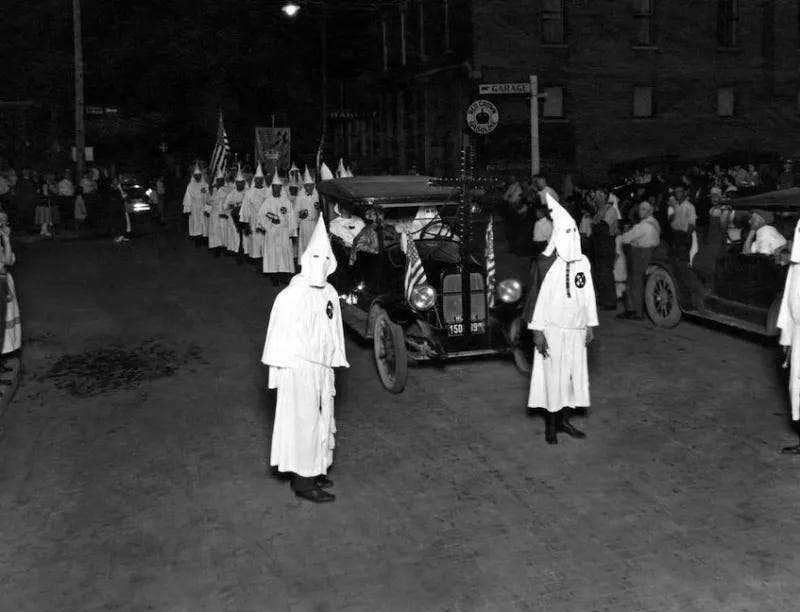
We need to dispel a myth.
The Ku Klux Klan was not only a Southern thing, and it did not only target Black Americans.
That first Klan is real, and what it did is abhorrent. It was founded in December 1865, in a judge’s law office in Pulaski, Tenn., by six former Confederate officers who were Democrats. Historians consider that the first wave, when those people aimed Reconstruction-era terror at Black people across the south. That history stands on its own and doesn’t get erased by anything that comes later.
But that’s not today’s story. This is about the second wave, when the Klan built its single largest chapter in Indiana, a northern state in the 1920s, just after World War I.
In Indiana, the Klan wasn’t selling hate. It was selling a story about “Americanism” and “reform.” They told people their protestant identity was under attack. That “real Americans” were losing their country. They said Catholics, Jews and Black Americans were taking over, and that only the Klan could save the nation. And all of this was sold wrapped in an American flag and Bible verses.
But how did they say these things? They planted stories wrapped in fear. Stories are much easier to tell than statistics are to repeat.
They didn’t say “look at those Catholics getting into politics.” They convinced people the Pope was secretly running America.
They didn’t say there were too many immigrants. They convinced their neighbors that their children wouldn’t grow up in the same America they did.
All along, the Klan was convincing people it was protecting people, protecting society.
But the ideology — the story they were carrying — was lost when its beloved leader kidnapped and raped a woman. She died from her injuries, and he was sentenced to life in prison.
And then he took everybody down with him — from prison.
Then, people believed a different story. The Klan corrupts our society.
Let’s go back in time
Indiana already had a history of hate. Sure, it was in the North. People didn’t believe in slavery. But just because they didn’t believe in slavery didn’t mean they wanted Black people for neighbors. In 1851, when Hoosiers voted on a new state constitution, they didn’t just ratify the document. They voted separately on a measure barring Black people from settling in Indiana at all. It passed, 113,828 to 21,873. Here’s the kicker: Black Hoosiers were already living in the state when that vote happened. They had thriving settlements, schools, churches, scholarship programs and organizations all over Indiana … until 1851. Then the population plummeted. It didn’t start to rise until after the Civil War and Indiana updated its constitution.
When D.C. Stephenson arrived in the 1920s, he wasn’t importing hatred to innocent ground. He came to Indiana from Texas, in the name of good, honest work. He was born in Houston in 1891 to a sharecropping family, but he was raised in Oklahoma. He was a printer’s apprentice who’d brushed up against the Socialist Party and served briefly in the Army during World War I.
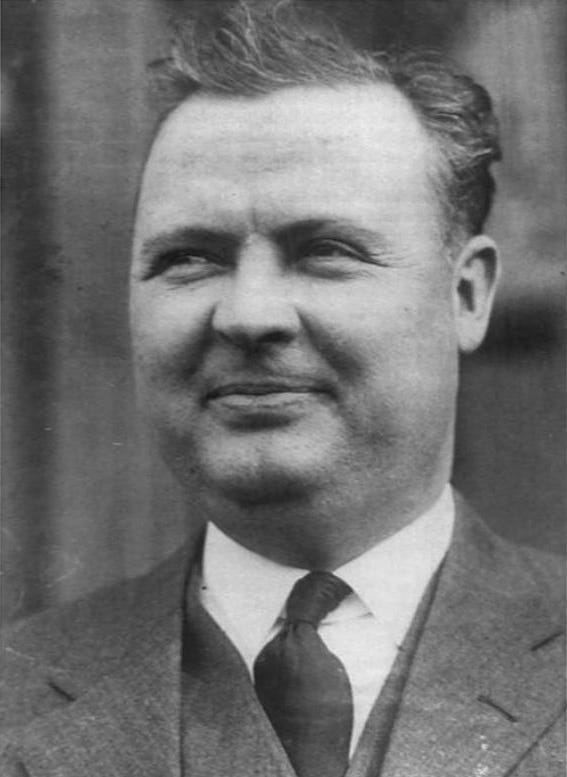
In 1920, at 29, he moved to Evansville, Ind., for a job with a retail coal company, and got involved in local Democratic Party politics. The Klan, and the empire he built inside it, came after. He wasn’t a Klansman who came to Indiana. He became one once he was already here, on ground that had voted for exclusion 70 years before he arrived.
How big ‘biggest’ actually was
Historian Leonard Moore spent years going through actual Klan membership rosters — not Klan self-promotion, not press estimates, the internal documents — for his book Citizen Klansmen: The Ku Klux Klan in Indiana, 1921–1928. He found that more than 25 percent of native-born white men in the state were dues-paying members. Other estimates from the period put it closer to a third. Either way, the round number is the point: this wasn’t a fringe. From 1922 to 1925, Indiana was the acknowledged center of the national Klan movement, with membership estimates for the state running from roughly 250,000 to over 300,000.
I do this work because I think history should be free … not paywalled, not clickbait. Every deep-dive I publish stays free, always.
But depth costs something to build, and community costs something to keep alive. The Community is $8 a month or $80 a year. It gets you the Historian’s Notebook (my take on what researching really looks like complete with pictures), Sunday night Zoom book study, and first access to new courses.
Free history is the front door. Paid membership is what lets me keep building the rest of the house. Every subscriber is a vote for more of this.
And it wasn’t hidden. Cross burnings were reported in Fort Wayne as early as Christmas season 1922. There’s a 1926 photograph of Klan members at the Main Street Interurban Terminal in Fort Wayne, a public gathering, not a secret one. This is the part worth sitting with if you grew up here: this didn’t happen somewhere else. It happened in the same towns, on the same streets, within living memory of people’s great-grandparents.
There were parades and picnics all across the state — from Evansville to Muncie and beyond.
The pitch
Stephenson was explicit about how he built that membership, and this is worth reading in his own words, because it’s the whole mechanism in one sentence, “I did not sell the Klan in Indiana on hatreds. That is not my way. I sold the Klan on Americanism, on reform.”
“Reform” meant temperance and clean government, in a state frustrated with Prohibition-era lawlessness and machine politics. “Americanism” meant a fraternal, civic, respectable-looking organization — parades, picnics, church socials — that also organized around hatred of Black Americans, Catholics, Jewish Americans, and immigrants. The wanting of political order, the racism, and hatred against religious groups were all part of the Klan’s ideological package. It is not a contradiction in the historical record. The Klan of the 1920s recruited through belonging, not through announcing itself as extremist. Nobody had to believe they’d joined a hate group, even if it was the product.
What happened to Madge Oberholtzer
Stephenson and his associate Earl Gentry forced Madge Oberholtzer onto a train to Hammond, where Stephenson raped and assaulted her so violently she was left covered in bite marks. At a stop, she bought bichloride of mercury and took it rather than continue to endure what was happening to her. Another Stephenson associate, Earl Klenck, carried her into her home and lied about a car accident. Her landlady didn’t believe him and called a doctor. Before Madge Oberholtzer died — over two weeks later, from the complications of what she’d ingested and untreated injuries — she gave a formal dying declaration to attorney Asa J. Smith, made “being in full possession of my mental faculties and conscious that I am about to die.” That declaration was admitted at trial and was central to Stephenson’s conviction.
The legal outcome is its own piece of the story. Stephenson didn’t kill Madge Oberholtzer directly. She died from the poison and/or the infection from the bitemarks. His conviction for second-degree murder rested on the argument, upheld on appeal by the Indiana Supreme Court in 1932, that his unlawful acts had rendered her incapable of exercising informed judgment, making her act a direct and foreseeable consequence of his own crimes. That’s a significant point in Indiana criminal law, separate from everything else this case is remembered for.
The list from the prison cell
Stephenson expected a pardon from Ed Jackson, the governor he’d helped elect, but it never came. So, Stephenson decided to get even. Starting in 1927, from his cell, he started planning. He got the paperwork from his lawyers, spoke to reporters and released the names of officials who’d been on the Klan’s payroll.
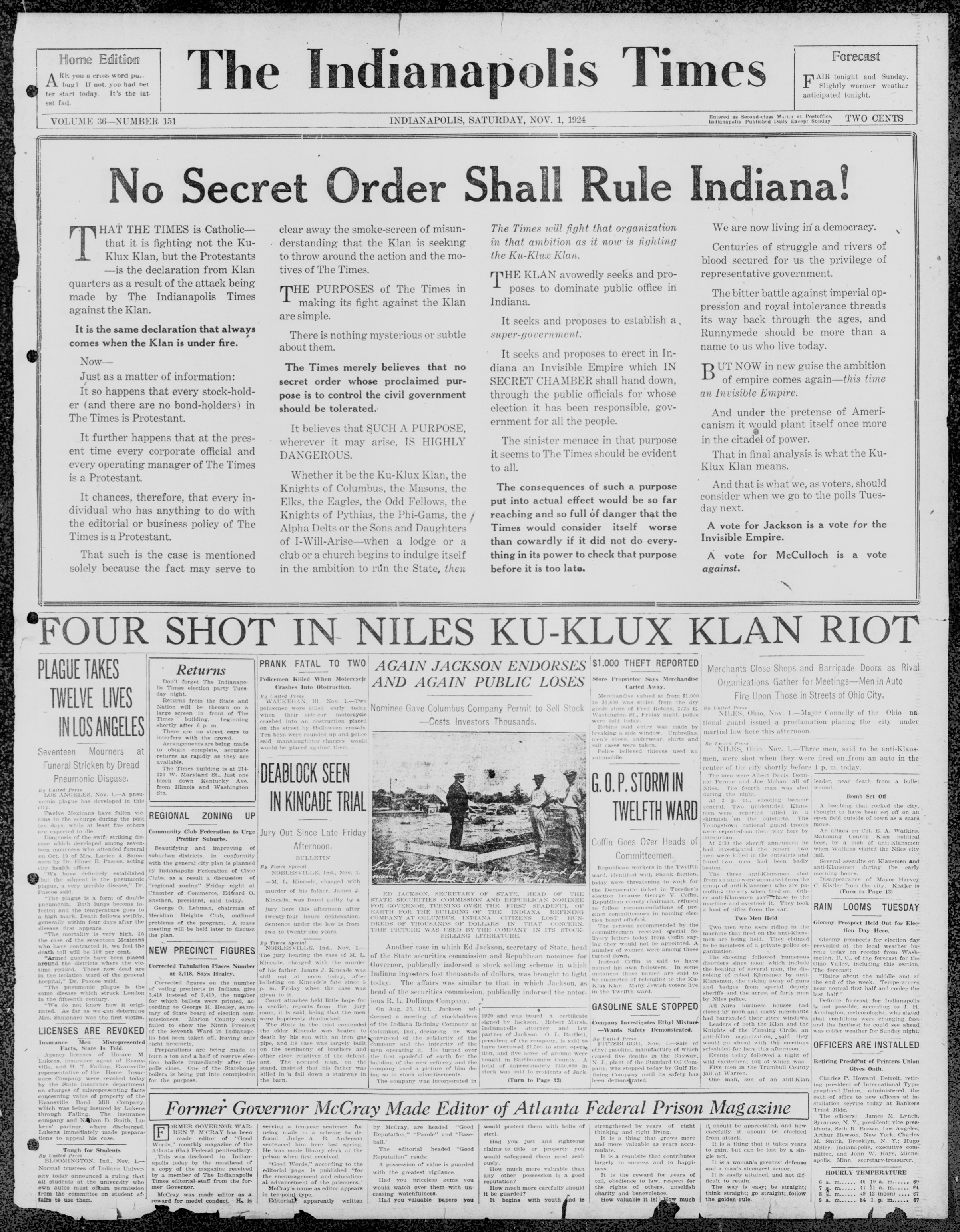
But it’s not one Stephenson saying he wanted to get even. Reporters took him seriously. As a former journalist, I cannot help but note the importance of the work of the reporters who followed the money, verified the documents and published evidence connecting the KKK to Indiana’s political establishment. Reporters Boyd Gurley and Edwin V. O’Neal had to follow old checks and documents linking the Klan to politicians. O’Neal went so far as to find one crucial letter that helped authorities find “Black Boxes” containing Klan records that helped expose the entire political network. The editor of the paper publicly said he would expose the corruption. The Indianapolis Times won a Pulitzer Prize in 1928 for exposing the connection between the political corruption in the statehouse to D.C. Stephenson and the Klan.
The Indiana Indictments
Governor Jackson was indicted in September 1927 for conspiracy and attempted bribery. The charges dated back to 1923, when Jackson was serving as secretary of state, to bribe outgoing Governor Warren McCray with cash and a promise of protection, in exchange for appointing a Klan-aligned prosecutor in Marion County.
Stephenson even testified for the prosecution. Jackson was not convicted because the statute of limitations had run out. During the course of the investigation they learned Stephenson gave Jackson $2,500 for his gubernatorial campaign. Jackson said it was for his horse, whom he named Senator. That was a lie. It turned out the horse cost $300 and had recently died after choking to death on a corn cob.
Indianapolis Mayor John Duvall, a Klansman elected in 1925, was convicted of violating the state’s Corrupt Practices Act and forced to resign. Six city councilmen were indicted for taking bribes and pleaded guilty.
None of this happened because the Klan was driven underground by public outrage. It happened because one man’s expectation of a pardon didn’t pan out, and he decided to burn down everyone who’d used him. The collapse was a falling-out among people already inside the machine, not a reckoning imposed from outside it.
Read the fine print
The scariest thing about hate isn’t when it hides. It’s when it doesn’t have to. The dangerous version of this isn’t the one hiding in the woods at night. It’s the one with a parade permit, a seat at the inaugural ball, and a membership roll that includes a quarter to a third of the neighborhood. The Klan of the 1920s didn’t have to conceal what it was doing, because what it was doing. It was recruiting through respectability, trading favors through elected office and looked, from the inside, like normal civic life.
That’s the fine print. The mechanism doesn’t need to be secret to work. It just needs to be familiar enough that nobody questions it.
Sources & further reading
Primary sources
Madge Oberholtzer’s dying declaration and trial testimony excerpts — The D.C. Stephenson Trial: An Account, Famous Trials (UMKC School of Law), famous-trials.com
Stephenson v. State, 205 Ind. 141, 179 N.E. 633 (Ind. 1932) — Indiana Supreme Court opinion, via Justia and CourtListener
Indiana Constitution of 1851, Article 13 (”Negroes and Mulattoes”), and the governor’s proclamation on the vote — Indiana Historical Bureau, in.gov
Indianapolis Times “Black Box” investigative series (1927–28), referenced via Hoosier State Chronicles, Indiana’s Digital Newspaper Program (in.gov)
D.C. Stephenson and Ku Klux Klan Collection — Indiana State Archives finding aid, in.gov/iara
Books
Leonard J. Moore, Citizen Klansmen: The Ku Klux Klan in Indiana, 1921–1928 (University of North Carolina Press, 1991)
M. William Lutholtz, Grand Dragon: D.C. Stephenson and the Ku Klux Klan in Indiana (Purdue University Press, 1991)
Timothy Egan, A Fever in the Heartland: The Ku Klux Klan’s Plot to Take Over America, and the Woman Who Stopped Them (Viking, 2023)
Archives & institutions
Indiana Historical Bureau (in.gov/history)
Indiana Historical Society — D.C. Stephenson and Ku Klux Klan records
Encyclopedia of Indianapolis (Indianapolis Public Library)
Indiana Memory digital archive — Allen County Public Library and Ball State University collections (Fort Wayne and Muncie Klan photographs)
Tennessee Encyclopedia — Ku Klux Klan founding, Pulaski, Tenn.
Growing up I heard that the Klan held rallies at Bixler Lake in Kendallville IN.