
Whose Values Get to Become Law?
Book Study Recap: The Power Worshippers Chapter 4

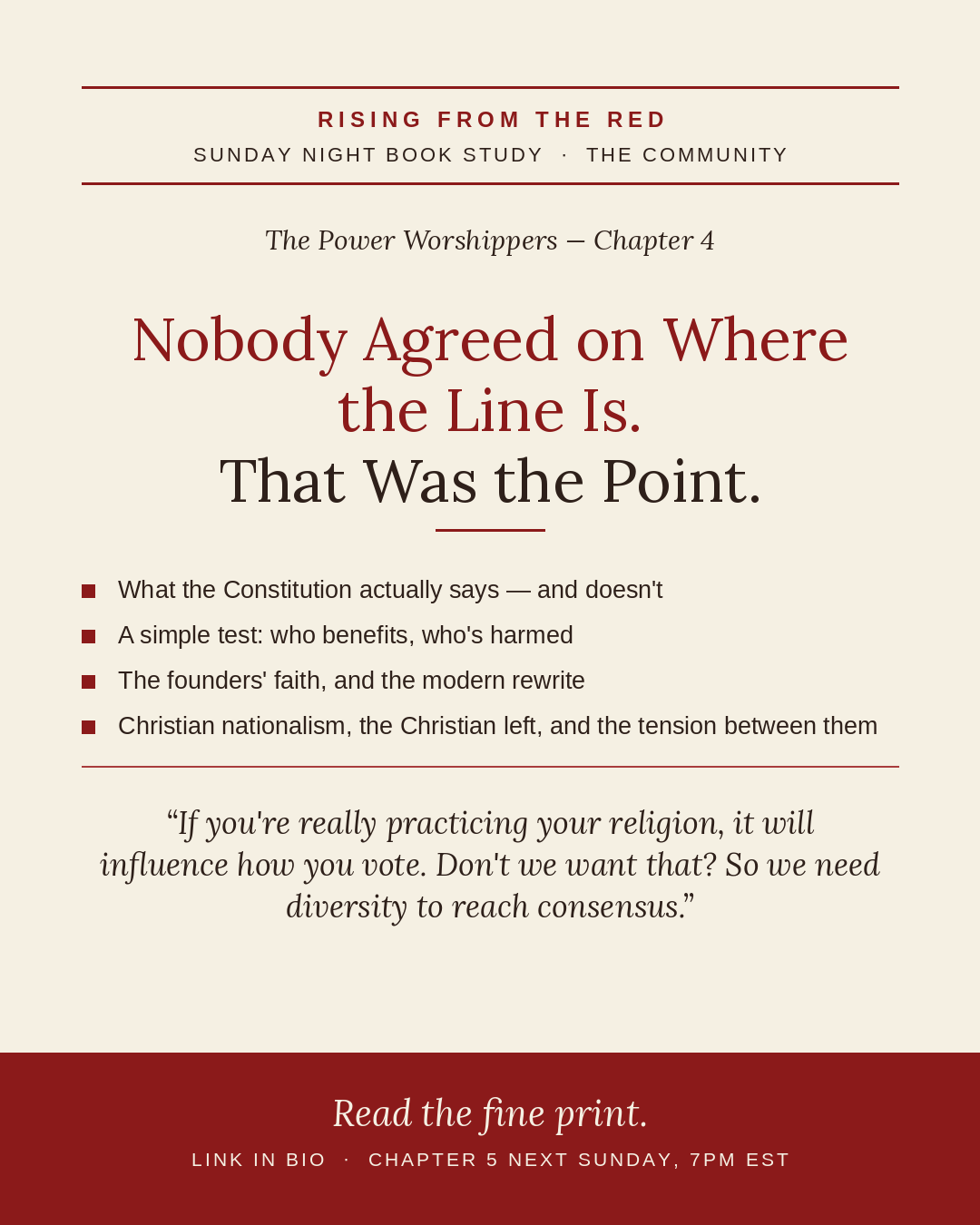
Chapter 4 of The Power Worshippers by Katherine Stewart sent us straight into the question we keep circling back to on these Sunday nights: what does separation of church and state actually mean in practice, when real people are trying to live their faith and vote their conscience at the same time?
We didn’t land on a clean answer. I don’t think there is one. But here’s where the conversation went.
The Constitution says less than people think … and more than people think
We started by getting the plain facts on the table. The words “separation of church and state” aren’t in the Constitution. What is there: no religious test for holding office, and no established national religion. That’s it. Everything else — how much faith should shape a lawmaker’s vote, whether a legislature can put the Bible in a classroom, whether a judge is required to marry a couple who hasn’t already been through a courthouse — is downstream interpretation, not settled text.
One member pushed on this directly: if you’re voting your values, and your values come from your faith, how is that meaningfully different from writing your faith into law? Another member drew the line differently — a belief shaping how you vote is not the same as that belief becoming what everyone is required to do. The group sat with that distinction for a while without fully resolving it, which felt honest.
A useful test: who benefits, who’s harmed
The best practical tool to come out of the night was simple. Before deciding whether a law reflects reasonable values or theocratic overreach, ask two questions: who does this benefit, and who does this harm? Seatbelt laws came up as an easy case — resisted at the time as government overreach, understood in hindsight as basic harm reduction. Prostitution and Sunday alcohol laws came up as harder cases, where “harm” is contested rather than obvious. Indiana’s own blue laws got some airtime here too — no Sunday alcohol sales until relatively recently, and to this day, no alcohol sales on Election Day, a rule explicitly about influence.
The founders’ religious identity, revised
We talked about how many of the founders were deists — believing in a creator but not in a revealed, divinely inspired text — and how that gets flattened in the modern retelling. The Christian nationalist narrative doesn’t just claim the founders were religious; it claims they intended a specifically Christian nation, not a religiously neutral one. That’s a rewrite, not an interpretation. One member, raised Pentecostal, talked about how her own seminary training taught her the opposite of what she’d absorbed growing up — that scripture was written and revised by fallible people across centuries, not delivered intact.
If you’re reading this and you’re not a paid subscriber yet — this is where The Community lives. Paid subscribers get the Sunday night Zoom, these recaps every week, and a running seat in a conversation that’s been going for months now. You also get access to our Tuesday Night Not A Christian Nation Study. This week, we’ll be looking at the financial record of the Pilgrims and begin to delve into what it was like for the Puritans before they left England. It’s $8/month or $80/year, and it’s the thing that actually keeps Rising from the Red sustainable. If you’ve been lurking on the free list and this recap is the kind of depth you want more of, join The Community.
Pluralism as a target
Someone shared a clip of a pastor arguing that religious pluralism — the idea that the state stays neutral and lets different worldviews coexist — is itself a kind of competing religion, and therefore not actually neutral at all. That reframing does a lot of work for Christian nationalist arguments: if pluralism is just another belief system, then privileging Christianity in law isn’t an establishment problem, it’s just picking a side in a contest that was never neutral to begin with. Worth sitting with, because it’s a more sophisticated move than “they’re persecuting us.”
Where the Christian left fits
A good chunk of the night went to the rise of a more visible Christian left — political figures speaking from faith toward inclusion rather than exclusion. The group was sympathetic but clear-eyed: is this a genuine, slow-building movement forty years in the making, born out of people quietly deciding to “do right” in their own schools and churches and towns? Or is it mostly a reaction to Christian nationalism’s visibility — Newton’s third law applied to religion and politics? Probably both. One member raised a real tension: when a Christian-left figure fights fire with fire — matching an opponent’s tactics rather than staying above them — does that undercut the moral distinction the movement is trying to draw? No consensus, but a good, honest question.
The generational and regional piece
Several members traced their own path — private Christian schooling built around resisting integration, without that ever being named as the reason at the time; blue laws that varied wildly by state and even by county; a slow, individual “waking up” that took decades, not a single moment. There was real tenderness in how people talked about parents and communities who weren’t cruel, just unexamined — and how much it costs, personally, to look back and see what you didn’t see then.
Where we left it
Closing thoughts ran toward complexity rather than resolution — a shared sense that the “wall” of separation is not, and maybe never was, hard and fast. Several people named a loss of civility and basic decency as the deeper story underneath the legal question. And more than one person landed on the same instinct: rather than fighting Christian nationalist arguments on their own terms, ask the people making them to sit with the actual teachings — humility, care for the poor and the stranger — that the loudest version of the movement tends to skip past.
We pick up Chapter 5 next Sunday, 7 p.m. EST. Zoom link, password and questions are below for paid subscribers.
